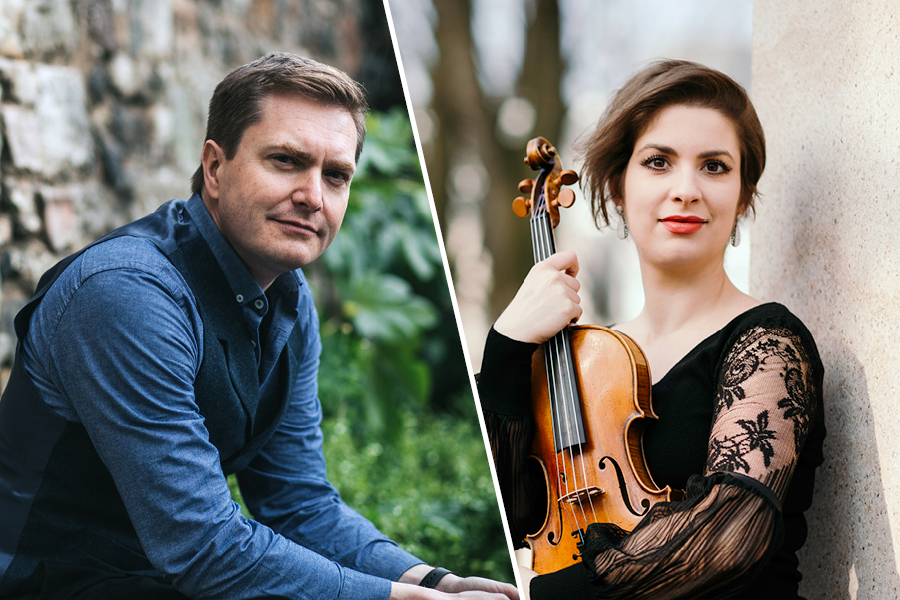
Goicea & Lowe
Vienna – the eternal magnetic center of musical genius and the stage of the greatest symphonic triumphs – is the invisible thread running through the final program of Allegra. The city of Beethoven, Brahms, and Johann Strauss II stands at the foundation of this evening’s festive catharsis.
The concert opens with the “Egmont” Overture – Beethoven’s musical monument to freedom. Composed in 1810 amid the thunder of besieged Vienna, the work transforms the tragic fate of Count Egmont into a radiant “Symphony of Victory”. In F minor, the composer paints tyranny through the rhythm of a sarabande, while the solitary oboe becomes the voice of hope. After the dramatic pause – the musical execution – comes the triumph of light.
This thread of spiritual strength continues in the monumental Violin Concerto in D major, Op. 77 by Brahms – the result of a long creative dialogue with Joseph Joachim. Nicknamed “a concerto against the violin” for its titanic difficulty, it turns the soloist into a thinker engaged in debate with the orchestra. The pastoral opening grows into dramatic double-stops, and in the second movement Brahms entrusts the main melody to the oboe – a test of the soloist’s artistic humility before the finale erupts in Hungarian rhythms.
Taking the stage is the exceptional Ioana Goicea, laureate of the most prestigious competitions and performer on a historic 1761 Guadagnini. Her intelligent tone and fiery temperament reveal the profound human emotion embedded in Brahms’s score.
From the fire of Hungarian rhythms, we move naturally to the overture to Johann Strauss II’s The Gypsy Baron – his most ambitious work, written for his 60th jubilee. Here Strauss transcends operetta and creates a musical monument to Austria-Hungary, filled with exotic motifs and the famous “Treasure Waltz.” The Hungarian color links Strauss and Brahms not only stylistically but personally – Brahms was among his most devoted admirers.
Under the baton of James Lowe, a master of orchestral balance, the Allegra Festival Orchestra turns the finale into a sonic firework. Thus the program completes its circle: from Beethoven’s heroic pathos, through Brahms’s philosophical depth, to Strauss’s sparkling Viennese joy – reminding us that art unfailingly leads toward the light.
Performers:
Ioana Goicea - violin
James Lowe - conductor
Allegra Festival Orchestra
Allegra Festival Orchestra
Program:
Ludwig van Beethoven
Overture to Egmont, Op. 84
Johannes Brahms
Violin Concerto in D major, Op. 77
Johann Strauss II (1825–1899)
Overture to The Gypsy Baron
Tickets:
Duration:
70 min
Alternative
Tickets can also be purchased at EasyPay cash desks.